

Call Tracking Is Mandatory
Every HVAC SEO campaign we build includes call tracking. We track which searches and pages produce booked calls, not just call volume. Ranking data without call data is incomplete.
More Booked Service Calls
When a homeowner searches 'AC repair near me' during a heat wave, they are not browsing options. They are calling whoever shows up first. HVAC SEO from DemandStream is built around how HVAC customers actually search and call. No generic contractor marketing.
One plumbing client and one HVAC client per market.
Where We Start
A ranking is not revenue. A booked call is. Before we build a single campaign, we look at call tracking data, your answer rate, and how your dispatch board handles volume during peak season.
An HVAC company with a 45% booking rate produces different results than one running at 72%.
That gap is addressable, but has to be identified first.
Every HVAC SEO campaign we build includes call tracking. We track which searches and pages produce booked calls, not just call volume. Ranking data without call data is incomplete.
Rankings tell us visibility. Booking rate tells us whether that visibility is converting to revenue. A company at 45% produces different results than one at 72%. That gap has to be identified before we scale volume.
A missed call during a July heat spike or a January freeze event is a job that went to your competitor. Emergency HVAC calls cannot go to voicemail. We identify the patterns before scaling volume.
If your board is full in July, we throttle. If February is slow, we push. Marketing that ignores your operational reality creates chaos. HVAC SEO has to align with how your season runs.
Local SEO must account for the operational realities of running an HVAC company. A strategy built without that context generates calls the operation cannot run.
The Problem With Generic SEO
HVAC is not a general home services business. It is a seasonal, regulated, capacity-constrained trade where the buying decision splits two ways: emergency repair or planned replacement.
Generic contractor packages apply the same keyword lists, the same content templates, and the same link tactics to every trade. They don't account for how no-cool calls behave differently than install inquiries, or what makes a homeowner choose one HVAC company over another when their system fails at 10pm.
When a homeowner's AC stops working in August, they don't browse. They search and call whoever shows up in the Map Pack. HVAC SEO has to be built around that urgency. Not applied from a template designed for every trade.
A homeowner searching 'AC not cooling' has different intent than one searching 'AC replacement cost.' Each requires a different page, different copy, and different conversion path.
An HVAC company ranking at the top from three miles away may not appear at all for a searcher across the service area. A strategy that ignores ZIP-level competition leaves high-margin calls on the table.
When a homeowner finds two HVAC companies in the Map Pack, the one with more recent reviews and a response to each one gets the call. Review recency and response discipline are direct ranking and conversion factors.
A homeowner searching 'heat pump installation near me' has different intent than one searching 'HVAC company.' Each distinct service needs its own page. Generic catch-all HVAC pages rank well for nothing.
HVAC emergencies don't follow business hours. After-hours calls are often the highest-margin jobs in the mix. Your GBP has to be configured to capture that demand 24 hours a day.
Effective HVAC SEO requires scoping to the actual market. Not templated outputs applied from a generic contractor package. That is why our HVAC SEO work performs consistently across different markets and service areas.
Effective HVAC SEO requires scoping to the actual market. Not templated outputs applied from a generic contractor package. That is why our HVAC SEO work performs consistently across different markets and service areas.
These outcomes only appear when strategy matches how HVAC demand actually works.
The calls that matter most in HVAC happen at the worst times. When your company ranks in the Map Pack and top organic results for emergency HVAC searches in your service area, those calls come to you. Every month you hold position, the calls keep coming.
Organic local searchers are pre-qualified. They found your company because you showed up for the exact service they needed in the area they needed it. A homeowner searching 'heat pump installation near me' who finds your dedicated install page is closer to booking than a general ad click.
If your HVAC company is not ranking for AC repair, furnace replacement, and heat pump installation in your market, a competitor is. A competitor with consistent GBP activity and strong service area pages will outrank you on emergency calls regardless of how good your techs are.
HVAC revenue spikes around heat waves, freeze events, and system failures. When your organic presence is strong year-round, not just during emergencies, you build a more stable baseline of maintenance, tune-up, and replacement calls. That baseline lets you plan capacity, manage payroll, and grow without relying entirely on seasonal spikes.
Ready to Own Your HVAC Market?
A short, no pressure conversation to understand your shop, your service area, and whether DemandStream is the right fulfillment partner for your next phase of growth.
One HVAC company per market. Real conversations, not sales calls.
Takes about 60 seconds to qualify. We'll follow up within one business day.
2026 Research
Based on Whitespark's 2026 Local Search Ranking Factors research.
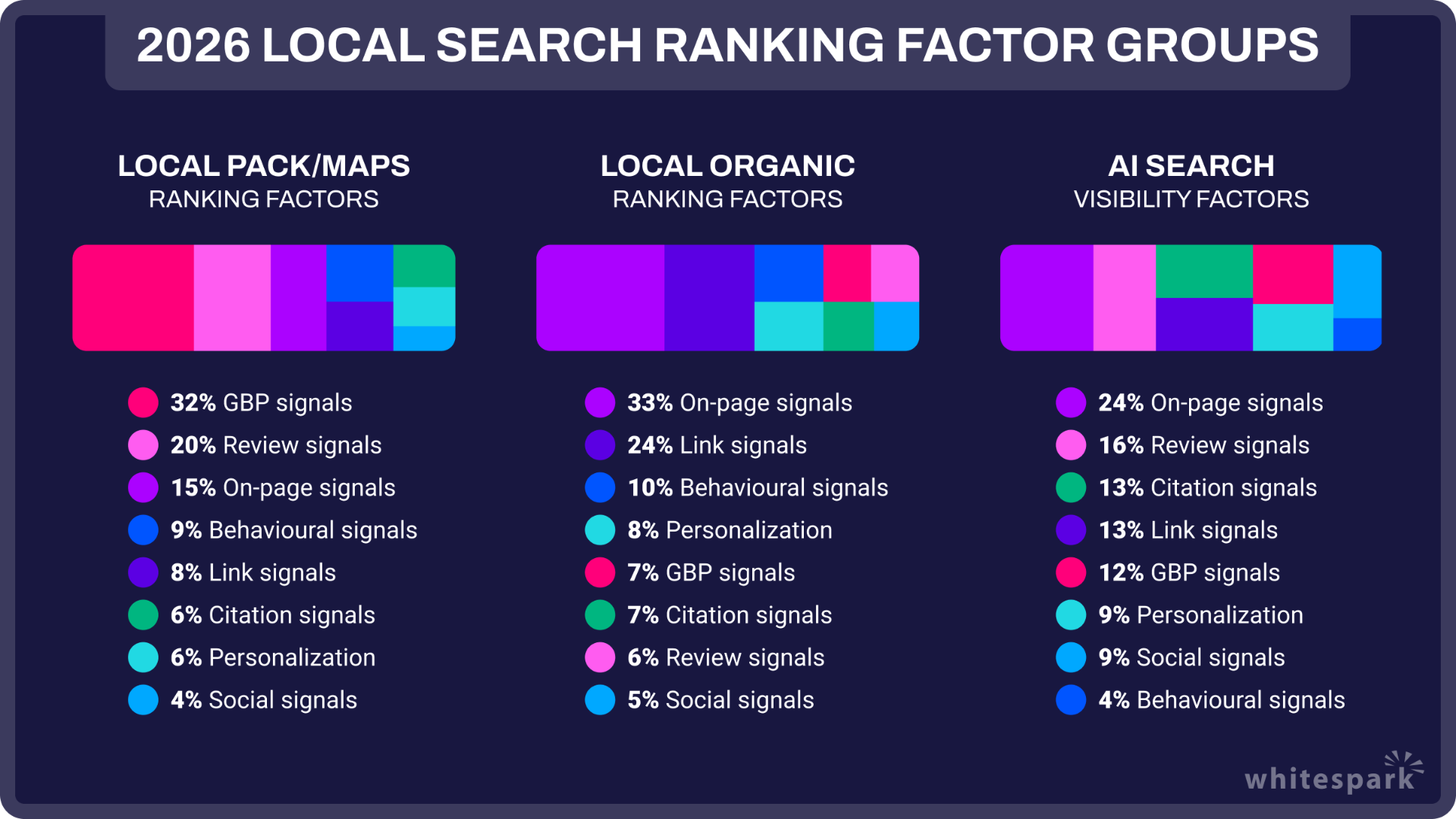
This research informs how we prioritize local SEO investment in every market we work in. GBP signals and review signals together account for over 50% of Map Pack ranking weight. Both are core to our system, not optional add-ons.
Source:
The Structure
Most HVAC companies think of SEO as one thing. It is three. Organic SEO, Google Maps, and AI & Generative Search each operate on different signals and drive different types of calls. All three have to work.
Organic rankings are structural. Built through page architecture, content quality, and authority signals. The most important structural decision: if it's a different type of call, it's a different page.
Service Cluster Architecture Every distinct service gets its own page. AC Repair, Furnace Installation, Heat Pump Systems, AC Replacement, Indoor Air Quality, each as a hub with sub-service pages targeting specific high-intent searches. AC Repair · Furnace Repair · Heat Pump · AC Replacement · Furnace Installation · Indoor Air Quality, each as a hub with sub-service pages targeting specific high-intent searches.
Maps rankings respond to GBP activity, review signals, and proximity. Over 70% of local service searches end at the Map Pack. For no-cool and no-heat calls, the Map Pack is where the revenue decision happens.
Maps IS BEHAVIORAL A GBP profile set up two years ago and never touched is losing ground to competitors posting weekly, uploading real job photos, and responding to every review.
AI Overviews now appear above organic results for a growing share of HVAC searches. A homeowner asking 'should I repair or replace my AC' or 'how much does furnace replacement cost' may never scroll past the AI answer. Your content needs to be the source that gets cited.
GEO vs SEO Traditional SEO earns rankings. Generative Engine Optimization earns citations inside AI answers: a different signal set, but built on the same technical and content foundation.
All three systems feed each other. Strong organic content supports Maps rankings. Reviews and structured data support AI citations. The system compounds when every channel is aligned.
The Process
A phased approach built for HVAC operators. Every phase has a purpose. Every phase builds on the last. We do not run campaigns before the foundation is solid. We do not chase rankings before the GBP is refined. We do not scale before we know your booking rate can handle the volume. The sequence matters.
Technical Foundation
Longest phase: Foundation typically spans 2 to 4 months depending on scope and market complexity.
Build a crawlable, revenue-aligned HVAC SEO structure that converts high-intent searches into booked calls. The technical foundation sets your ranking ceiling. An HVAC company with a slow, poorly structured site and duplicate service pages cannot outrank a competitor with clean architecture, no matter how many links they build.
What This Phase Includes
GBP & Maps
Win Map Pack visibility for the HVAC searches that drive emergency calls and same-day bookings. The Map Pack is where most emergency HVAC calls originate: an AC breakdown on a 98-degree afternoon, a furnace failure in a snowstorm, a heat pump that stopped working overnight. If your GBP is incomplete, stale, or miscategorized, you are invisible at the moment the revenue decision happens.
What This Phase Includes
Authority & Reviews
Build the prominence signals that stabilize rankings and strengthen trust on every call. HVAC is a trust-first trade. Before a homeowner lets a technician into their home, they check reviews. Before Google ranks an HVAC company in the Map Pack, it evaluates authority signals. Both processes reward the same inputs: consistent reviews, credible links, and clean citation data.
What This Phase Includes
Market Defense
Protect your HVAC market position and scale strategically as capacity allows. Rankings are not permanent assets. Competitors improve their GBPs, run review campaigns, and build new service pages. Market defense is not passive maintenance. It is an active, ongoing process.
What This Phase Includes
AI & GEO
Position your HVAC company to be cited by AI Overviews and generative search engines — not just ranked on the traditional blue-link results page. Search behavior is shifting. AI-generated answers are appearing above organic results for informational and service-intent HVAC queries. If your content and schema are not structured for citation, you are invisible to an increasing share of searchers.
What This Phase Includes
Most HVAC companies see meaningful ranking movement within 3 to 4 months, with significant Map Pack improvement by month 6.
The Levers We Pull
Each component is scoped based on your HVAC market's competition level, your current rankings, and your specific revenue goals. No standard packages. No fixed deliverable lists that ignore what your market actually requires.
TECHNICAL
Service-specific title tags, meta descriptions, and on-page content for every distinct HVAC service and city. Built to rank for 'AC replacement near me,' not generic contractor terms.
Site architecture, crawlability, Core Web Vitals, and page speed that set your ranking ceiling. Most emergency HVAC searches happen on a phone.
HVAC-specific keyword research covering emergency intent, repair intent, install intent, and location intent. AC repair, furnace replacement, and heat pump installation each get different priority weights.
AUTHORITY
A dedicated page for every distinct HVAC service and call type, plus city pages and long-tail content targeting searches like 'how much does AC replacement cost' and 'signs your furnace needs replacing.'
Local and trade-specific outreach: ACCA links, supplier directories, chamber listings, and community publications. Every link evaluated for geographic and trade relevance, not just domain authority.
Structured data, FAQ schema, and content formatting that positions your HVAC business for AI Overviews and generative search citations. So you get cited, not just ranked.
VISIBILITY
Citation audits and cleanup across Yelp, HomeAdvisor, Angi, BBB, and all major data aggregators. Consistent NAP data strengthens both Maps and organic rankings.
Post-job review acquisition and response systems built for HVAC companies. Structured to turn every completed job into a visible 5-star review.
Full GBP buildout and ongoing management: category setup, photo strategy, posting calendar, and response discipline. Not a one-time setup. An ongoing ranking activity.
Who We Work With
Most HVAC companies run good operations. The techs show up, the work gets done right, and the customers are happy. The problem is that none of that matters for the next call if the phone doesn't ring.
We work exclusively with plumbing and HVAC companies. Not general contractors. Not home services. Everything we build is structured around how HVAC customers actually search and call.
The highest-value HVAC calls: no-cool in July, no-heat in January, system failures. All emergency-driven. We build your SEO to capture those searches first.
As your install revenue grows, the SEO architecture scales with it. Every new service area gets a new ranking asset. No duplicate content, no doorway pages, clean geographic expansion.
We take one HVAC client per service area. When you work with DemandStream, your competitors don't. The strategy we build is designed to put you ahead, not split between you and the shop down the street.
Selective Fit
We work best with established HVAC companies that want to own their service area, not just generate a few more calls this month.
We build strategies for HVAC operators that can handle the call volume local SEO produces.
We measure success in booked calls and cost per booked call, not vanity metrics.
The first three to four months are foundation work that everything else builds on.
Review signals account for a significant portion of local ranking weight. This is non-negotiable.
Rankings are a means to an end. Booked calls are the end.
GBP is the foundation of Map Pack visibility. A hidden-address profile has structural limitations no optimization can fully overcome.
If someone promised you fast results, they were not being honest. Real HVAC SEO takes time and consistent effort.
These profiles face significant structural limitations in local search that no amount of optimization can fully overcome.
Review velocity is a mandatory part of the system. HVAC companies that skip this step cap their Map Pack potential.
Anyone guaranteeing rankings is either misleading you or has no ability to keep the promise. Google controls its algorithm.
Effective HVAC SEO in a competitive market requires real investment. We are not the cheapest option. We are the option that produces results.
The first three months are foundation work. You need time for the system to compound before evaluating results.
What HVAC Operators Say
Common Questions
For most HVAC companies, meaningful ranking movement begins within 3 to 4 months of completing the technical foundation phase. Map Pack visibility improvements typically follow in months 4 through 6, assuming the GBP improvement phase runs concurrently with on-page work. The timeline depends on three variables: your current baseline, your market competition, and how quickly we can close technical gaps. An HVAC company in a mid-sized market with a relatively clean site and moderate Map Pack competition moves faster than one in a dense metro going up against five well-refined competitors. What we can say with confidence: HVAC SEO compounds. The calls generated in month 8 come from foundation work done in month 2.
We do not publish package pricing because every engagement is scoped to your specific market, competition level, and revenue goals. An HVAC company in a smaller market with a clean GBP and a solid existing site has different needs than one in a large metro competing against 30 active HVAC SEO campaigns. What we can tell you is how we frame cost: every dollar invested in HVAC SEO should be measurable against booked calls and cost per booked call. If we cannot show a clear line from marketing spend to calls on your dispatch board, the spend is not justified.
No. Any agency that guarantees specific ranking positions is either misleading you or making a promise they have no ability to keep. Google controls its algorithm. We do not. What we control — and what we are accountable for — is execution quality: technical foundation, GBP improvement, review velocity systems, link building, and service cluster content. Those inputs, done correctly and consistently, produce ranking improvements in virtually every market we operate in. We measure success in booked calls, booking rate, and cost per booked call — not in rank position fluctuations.
Existing rankings are an asset we build on, not something we reset. If your HVAC company already ranks for some searches, the audit phase identifies which rankings are stable and producing calls, which are fragile and at risk, and which service areas and keywords have significant untapped opportunity. A common pattern we see: an HVAC company has decent rankings for 2 or 3 broad service terms but almost no visibility for high-value searches like 'AC replacement near me,' 'heat pump installation,' or specific service area combinations.
We measure against the numbers that matter on an HVAC operator's dispatch board: booked calls, answer rate, booking rate, cost per booked call, and source-level call attribution. Rankings are a leading indicator, not a success metric. Monthly reporting includes ranking movement for target keywords and service areas, GBP performance metrics — calls, direction requests, and profile interactions — review velocity, and call tracking data tied to organic search.
Both, ideally — but with different expectations for each. Google Ads delivers immediate visibility for emergency HVAC searches. If someone searches 'AC repair near me' right now, a well-run Google Ads campaign can put you in front of that caller today. HVAC SEO cannot do that in week one. What HVAC SEO does that paid ads cannot: it builds a compounding asset. Rankings you earn in month 4 keep producing calls in month 14 without additional spend.
Paid ads generate calls while the campaign is running. When the budget stops, the calls stop. HVAC SEO generates calls that compound over time. Rankings built in month 3 continue driving booked calls in month 18, month 24, and beyond — without proportional increases in spend. The two are not mutually exclusive. Paid ads are often the right strategy during the ramp-up phase of an SEO campaign, especially for emergency HVAC searches where immediate visibility matters.
Yes. Install leads and repair calls require different page architectures. A homeowner researching 'AC replacement cost' or 'how long does a heat pump last' is in a different stage than one searching 'AC not cooling near me.' Install-focused content — replacement cost guides, repair vs. replace comparison pages, system lifespan content — targets the research phase and pulls in higher-ticket leads before the homeowner has already chosen a competitor. We build both: emergency capture pages for repair demand and research-phase content for replacement and install pipeline.
Emergency search volume spikes during heat waves and freeze events. An HVAC company with a strong Map Pack presence and emergency-specific landing pages captures a disproportionate share of those calls when demand is highest. The companies that see the largest peak-season gains from SEO are the ones who built their foundation during shoulder season — so when July or January hits, the infrastructure is already in place. SEO built for peak demand has to be executed before peak demand arrives.
Link building for HVAC SEO focuses on trade relevance and geographic relevance — not raw domain authority. A link from the Air Conditioning Contractors of America (ACCA), a regional HVAC supplier directory, a local Chamber of Commerce, or a community publication carries more weight for an HVAC company's local rankings than a generic high-DA link from an unrelated industry.
No. We take one HVAC client per service area. When you work with DemandStream, your direct competitors in that market do not. This is a deliberate model. It keeps our incentives aligned with yours and makes sure the strategy we build is designed to put your company ahead — not split across two or three competitors in the same ZIP codes. If your market is available, it is worth finding out before a competitor does.
Yes. Many of our HVAC clients come to us after working with generalist agencies that produced rankings without revenue, or activity without transparency. We start with a full audit of what exists — what is working, what is not, and what may have been done that needs correction. We do not approach this with blame toward the previous agency. We assess the baseline, identify the gaps, and build from what is there.
We work with HVAC companies running 2 trucks through multi-location operations. The common thread is not size — it is mindset. The HVAC operators who see the strongest results are the ones who treat marketing as an investment aligned to operations, not an expense that should produce immediate returns.
You receive a monthly report that covers what actually matters on your dispatch board: booked calls by source, ranking movement for your target HVAC keywords, GBP performance metrics — calls, direction requests, and photo views — and review velocity. No vanity dashboards. No impressions graphs. The numbers that connect back to revenue.
Ready to Own Your Market?
Tell us where you operate and what you're working toward. We'll take it from there.
One HVAC company per market. Your competitors don't get in.